









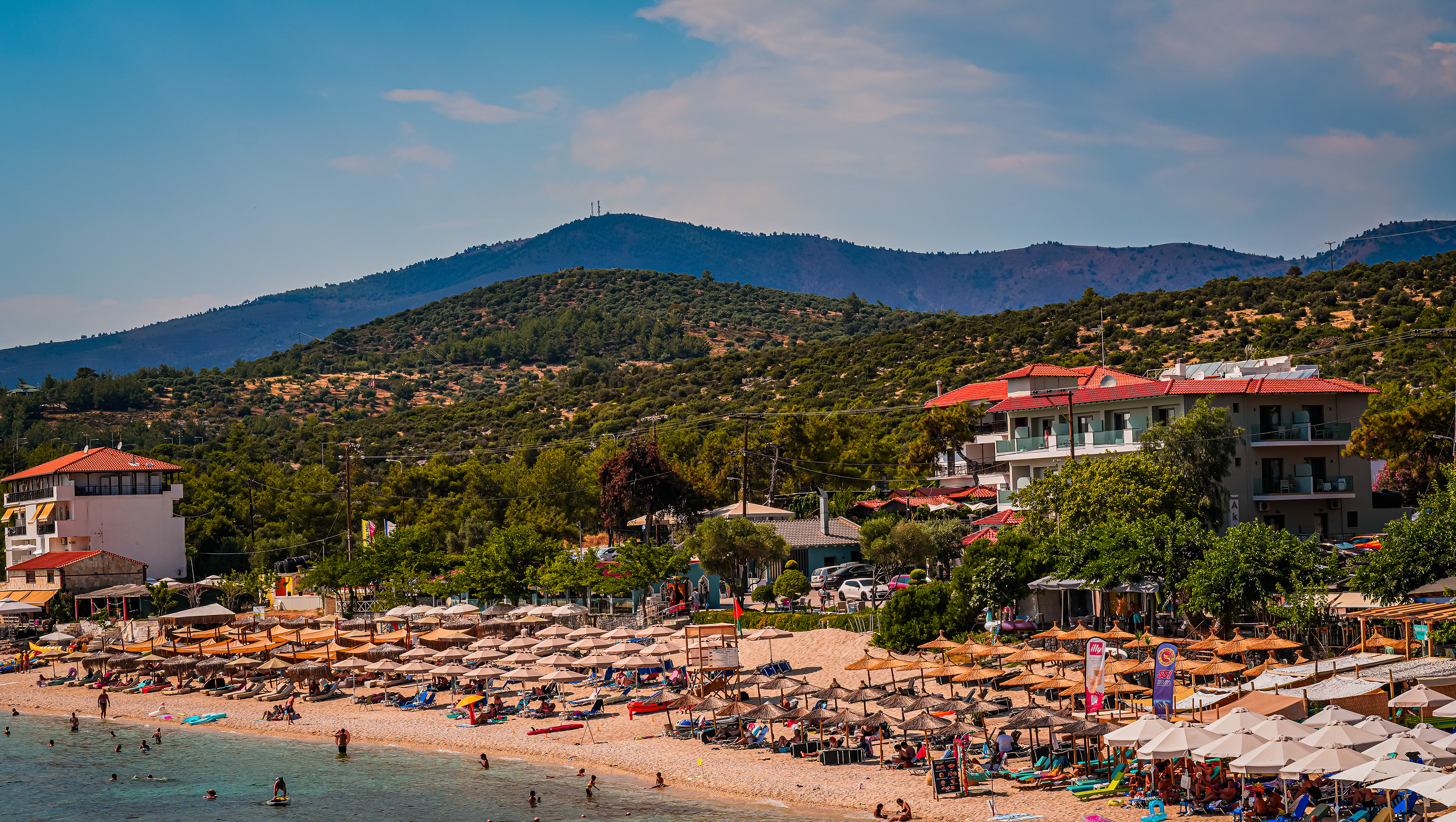
Thassos: Gold, Marble and Burnt Forest
Ten minutes out of Keramoti the sun on deck is still bearable. A dark green ridge rises ahead, and in the middle of that ridge, in the middle of August, sits a white patch that looks like snow.
Closer in, the patch resolves into a marble quarry cut out of the mountainside.
Most writing about Thassos opens with the beaches. Yet the beaches, the temples and the abandoned factories of this island are all relatives of that white patch. Thassos covers 380 square kilometres and had 13,104 residents at the 2021 census. Herodotus sailed here to settle an argument, a German mining company built an entire town out of nothing, and the emerald island nickname is far younger than it sounds. The rest of this guide follows those three threads.
The temple Herodotus came to check
Herodotus travelled to Tyre to settle a question about the age of the world. The priests of the Herakles temple there did not convince him, so he took a ship to Thassos, and he later wrote that the temple he found on the island had been built by the Phoenicians. The name of the island comes from the same story: Thasos, son of Agenor, who set out in search of Europa.
Greeks arrived from Paros around 650 BC. The best known of them was Archilochus, a poet relaxed enough to record in verse that he had thrown away his shield on the battlefield. He dropped it during a skirmish against the Thracian Saioi, saved his own life, and remarked that he could always buy another one. The same man was not sentimental about his island either, describing it as a donkey's backbone crowned with wild wood.
What lay under that backbone was gold. Herodotus reports that the best mines were on the eastern side, facing Samothrace. The combined annual revenue of the island mines and the mainland holdings came to somewhere between 200 and 300 Attic talents, which was enough to keep a mid sized fleet at sea for years.
The mining habit runs far deeper in time. At the site of the Tzines iron mine there is a shaft dated to roughly 13,000 BC, dug in the Palaeolithic to extract ochre. People here went underground thousands of years before anyone on the island learned to farm.
The columns left under the water
In the southeast of the island, 32 kilometres from Limenas, a small peninsula called Aliki holds two coves. Anyone who wades in a few metres finds enormous squared blocks underfoot. Half finished columns, broken pieces abandoned where they cracked, edges still sharp.
This was a quarry opened in the 7th century BC that worked for roughly 1,200 years before it was abandoned in the 7th century AD. Its whole commercial advantage was the water: stone did not have to be hauled down a mountain, it went straight onto a ship. The marble of the Arch of Galerius in Thessaloniki is said to have come from here.
On the high ground stand the remains of two early Christian basilicas from the 5th century. Beneath them lies an older sanctuary, though the sources disagree about who it was dedicated to; Demeter, the Dioscuri and Apollo all appear in different accounts. The one certainty is that sailors calling here carved their own names and the names of the people they loved into the steps.
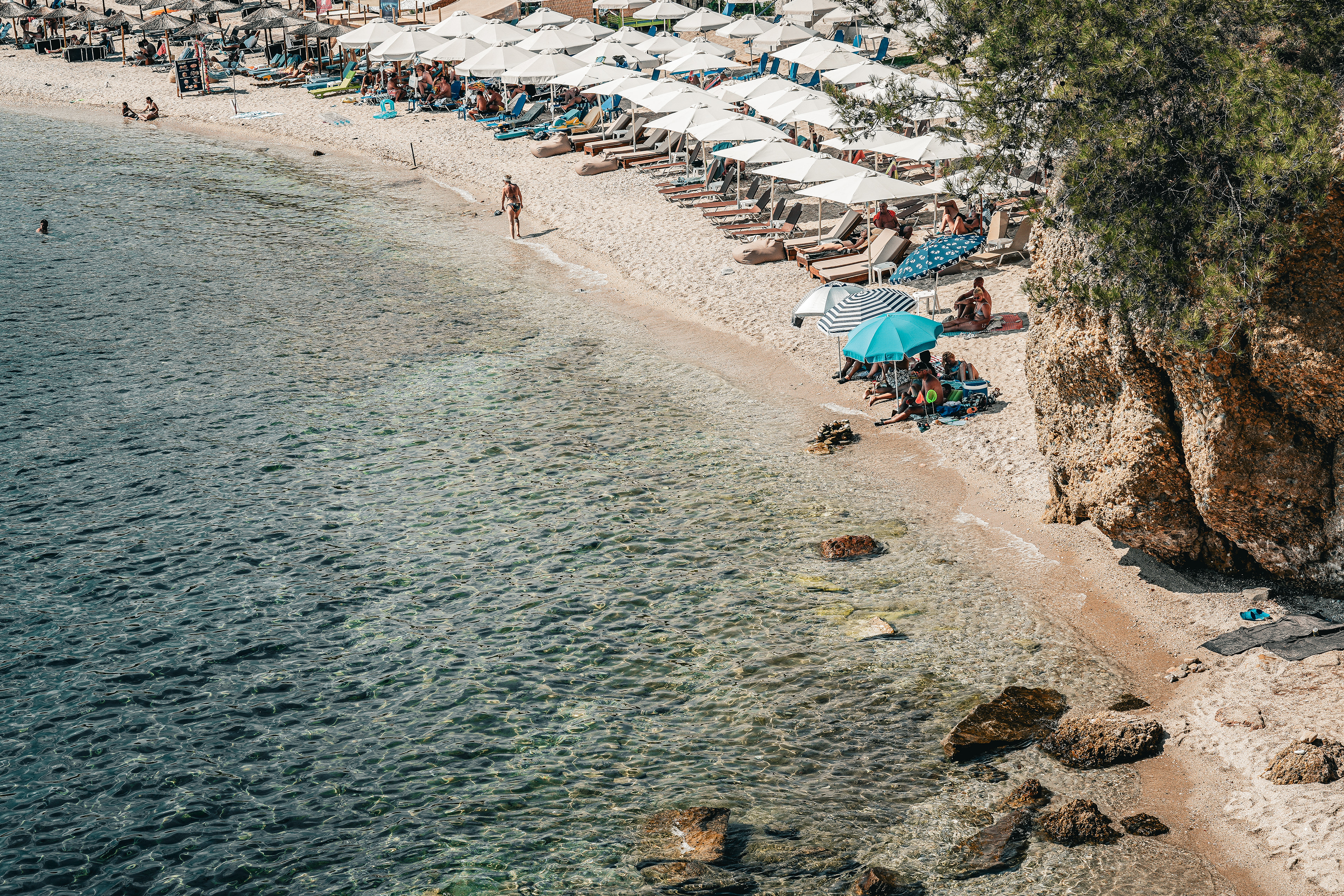
The modern version of the same stone sits in the north, at Saliara. Everyone calls it Marble Beach, because the pebbles underfoot are white spill from the working quarry directly above it. The odd pale turquoise of the water comes from the same source, white stone on the seabed throwing the light back. The dirt track past Makryammos turns a car chalk white, and for anything without four wheel drive the last stretch is easier on foot.
The theatre, fourteen years later
On the slope above Limenas, at the foot of the acropolis, sits an ancient theatre. Its first building phase belongs to the early Hellenistic period, the end of the 4th century BC. From the 1st century AD the orchestra was converted into an arena, the side entrances were sealed, and gladiator fights were staged here.
The theatre had been closed since 2011. It reopened in July 2025, fourteen years later. The restoration team lifted and repositioned 1,039 architectural members. The hardest part was sourcing stone: the composition of the marble in the ancient seating was analysed, then matching marble was quarried on the island. Two thousand three hundred years apart, the same mountain, the same stone.
The first performance took place last summer, the National Theatre production Fragments of Euripides. The Archaeological Museum below holds the largest sculpture on the island, a kouros 3.5 metres tall carrying a ram on his shoulder. It was carved from local marble between 600 and 580 BC and found broken on the acropolis in 1911. It now stands restored in the entrance hall.
The island that fled uphill, then came back down
A strange pattern shows up in the villages of Thassos: almost every inland village has a twin on the coast carrying the same name. Maries and Skala Maries, Panagia and Skala Panagia, Prinos and Skala Prinos. Skala means stair, used here for the road that linked a mountain village to its landing place.
The reason is not romantic. Through the centuries of piracy people could not live on the shore, so they withdrew uphill. When a Russian fleet briefly held the island between 1770 and 1774, the population had long since settled inland.
The administrative centre sat in the mountains for the same reason: Theologos. An Ottoman tax register of 1519 records the village under the name Tologo. In 1813 Mahmud II handed the whole island to Mehmed Ali Pasha of Kavala as personal property, so it was run less like a province and more like one man's estate. The Greek navy arrived in October 1912 and more than 350 years of Ottoman rule ended.
Theologos still stands with its stone houses and narrow lanes, and its building code has been protected since it was declared the cultural capital of the island in 1979. Most people who drive up in the late afternoon come for the same thing, lamb and goat turned on the spit. It is the dish the island is known for.
Palataki, the town a mining company invented
On the rock at the end of Limenaria harbour stands a two storey building with a small tower at each end and empty windows. Its name is Palataki, the little palace. It was built in 1903 by the Italian architect Pietro Arigoni as the head office of the German company Speidel.
Speidel came for the zinc and lead deposits, and the effect went far beyond one building. The mountain village of Kastro emptied out as people came down to the coast for work, and Limenaria was founded that way. After Lausanne, refugees arriving from Anatolia settled immediately next door, in a place they called Kalivia, meaning huts. The two settlements are no longer distinguishable from one another.
The end came quickly. The price collapse of the 1930s stopped ore processing, iron mining produced around three million tonnes between 1954 and 1964, and then it was over, because ore from Africa and South America was cheaper. Mining stopped altogether in 1962, Palataki was abandoned in 1963, and it has been empty ever since.
The shore directly below is called Metalia, the beach of the mines. Where the sand runs out, the concrete of the old ore ramps begins. Swimmers here have an industrial ruin behind them and open sea in front.
How old the green island really is
Thassos is marketed as the emerald island. There is a harder fact underneath the nickname.
The fires of 1984, 1985 and 1989 destroyed more than 80 percent of the total forest area. The 1985 fire alone burned 10,405 hectares and the 1989 fire 5,700 hectares. For comparison, the large fires earlier in the century covered 1,500 hectares in 1928 and 1,700 in 1938.
On the night of 10 September 2016, lightning during a storm started fires at four separate points on the island. The mountain village of Kazaviti was evacuated, at least eight houses were damaged, two monasteries were cleared and a state of emergency was declared. Around 300 firefighters, soldiers and volunteers worked on the ground.
This is why most of the Calabrian pines along the road today are young. The burnt ground regenerated on its own, reaching a density of two to six seedlings per square metre in the first spring. The colour of a hillside changes accordingly: one ridge dark and mature, the next one lighter and all of a single height.
How to get to Thassos
The island is reached only by ferry. The crossing from Keramoti to Limenas takes 35 to 40 minutes, with 38 sailings a day on the 2026 summer timetable, running from 04:30 in the morning to 22:30 at night. The line from Kavala to Skala Prinos takes 1 hour 15 minutes with five sailings a day. Tickets are not sold online, only at the booths inside the ports.
For anyone bringing a car the queue logic matters: buying the ticket at the booth is what secures a place in the boarding line, so in summer arriving 45 to 60 minutes before departure is the comfortable margin.
How a day fits together
Leaving Limenas around eight in the morning for Saliara is the easiest window, since the small cove fills after 10:00 and the parking runs out. The drive back into town takes about twenty minutes.
Late morning suits the ancient agora, the theatre and the museum. All three are within walking distance, and the path up to the theatre is short but steep. There is no shade at midday, which makes the museum a sensible place to spend the hottest hour.
In the afternoon the eastern branch of the ring road leads south to Aliki, where swimming and the ancient quarry sit in the same cove. Aliki is 32 kilometres from Limenas, roughly 45 minutes.
Late afternoon offers two options. One is to carry on southwest to Giola, where a stony walk of 10 to 15 minutes follows the car park and flip flops are a poor idea. The other is to climb to Theologos and have dinner there. When the pool is crowded, the second option is the better evening.
Closing
On the ferry back, anyone who steps out on deck and looks behind will still find that white patch in place, turning pink in the evening light.
The same stone lies as a half cut column on the seabed at Aliki, has become a theatre step again in Limenas after twenty three centuries, and crunches underfoot as pebbles at Saliara. Herodotus came to this island to find out who built a temple. Archilochus compared it to a donkey's backbone and left. Both of them were right.
This is a place that made everything on it out of its own stone. The rest is sea.


